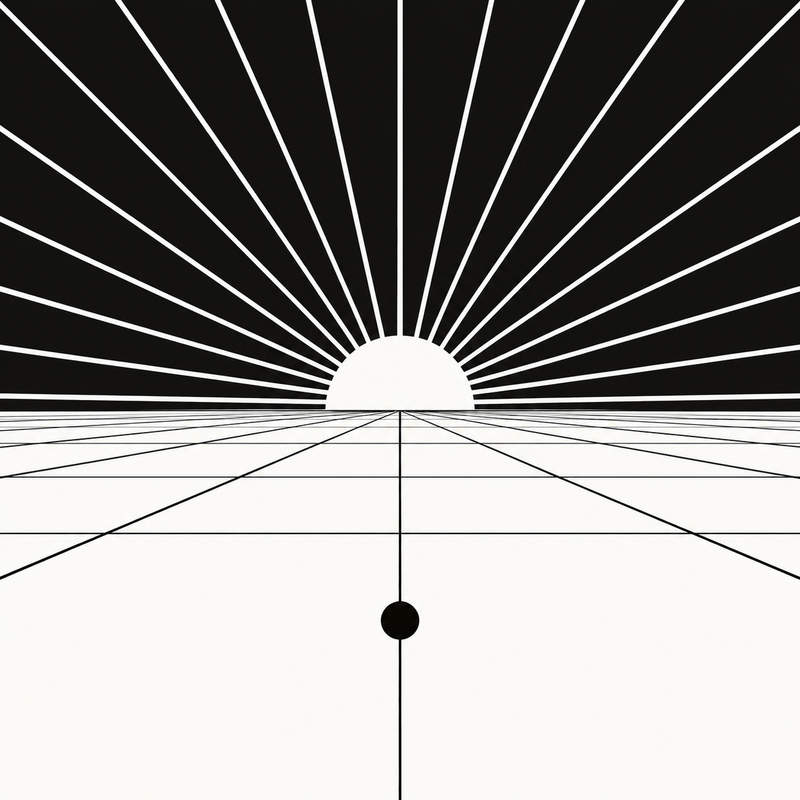
 The point woke at the center of the plain and couldn't remember arriving.
It
had, it believed, always been here, a small dense node of attention
fixed at the intersection of two coordinate lines drawn long ago by a
surveyor whose instruments had since oxidized into the soil. Around it
the terrain stretched in all directions, motionless: a drained basin of
pale concrete, its hairline fractures radiating like the ribs of a wheel
that would never turn.
The point didn't know what it was. This
was the first fact of its existence and, it suspected, also the last.
Each morning it conducted a census of itself, one unit, indivisible,
dimensionless. There was, occasionally, a remainder. The point did not
count it. Memory, it had concluded, was a luxury of extended bodies. The
point had no inside in which to keep its past. Whatever it had been
before waking had been left somewhere along the radius, scattered like
survey markers pulled from the ground and abandoned where they fell.
What the point did have was the horizon.
The
horizon stood at an unmeasurable distance in every direction, a perfect
circle of grey light where the plain surrendered to the sky. The point
had studied it for what it estimated to be several thousand years,
though the units of this estimate were its own invention. It had formed
hypotheses. The horizon was the edge of the world. The horizon was the
point's own pupil, dilated. The horizon was a boundary condition in an
equation whose other terms had been lost.
The point had attempted
expeditions. By an immense effort of will, the only fuel available to a
dimensionless intelligence, it had displaced itself across the plain, a
migration so slow that the cracks in the concrete had time to widen
into ravines behind it. Yet the horizon receded at precisely the rate of
approach. This recession was the horizon's only confirmed property: it
was defined entirely by its refusal. It was not a place. It was a
behavior.
There were, the point came to realize, other points.
It
found their traces in the basin, faint depressions in the concrete,
small centered absences, like the footprints of vanished surveyors or
the vacated nests of a geometry that had migrated long ago. Some of the
depressions were old, worn smooth. Some were fresh. The point
understood, with the chill of a laboratory result, that it was not the
first of its kind to occupy this plain. The others, too, had striven
toward the horizon. The plain kept no record of whether any had arrived.
Perhaps,
the point thought, the forgetting was not an accident. Perhaps it was a
mercy the plain administered on its own, so that each point might
undertake the long approach as though it were the first. It didn't
pursue this thought further. There was nowhere in it to keep the
thought.
In the evenings, if the dimming of the grey light could
be called evening, the point rested at the center of its small
depression and regarded the horizon with something it chose not to name.
The horizon, for its part, remained equidistant and serene, a circle
that was also a sentence, drawn around the point like the margin of an
unfinished diagram.
The point resumed its approach at dawn.
Somewhere
behind it, in the concrete, a new depression was already forming, as
though the plain were making room. The horizon held its distance, grey
and exact. The point walked on.
The Point And The Horizon
A short story by Vicenzo P DeMaar