 Watch an empire get built up close, and a pattern shows up that luck alone doesn't explain. The people driving it read the rules the scoreboard actually rewards, not the ones printed in the brochure. They read them with a clarity that borders on unfair, and they bend almost every decision toward that reading.
So what produces that kind of power? It's a stack of traits, and the stack matters more than any single layer. They treat the given order of things as material you can reshape, where most people experience it as gravity. They'll look visibly, uncomfortably wrong for stretches, trusting their own read over the room's disapproval. They repeat one narrow thing with a depth most people would find monotonous to the point of pathology: this is what their attention does at 2 a.m., unbidden. And underneath all of it, the quiet part: an unusually direct wire between wanting something and moving toward it. Other people debate whether they're allowed to want a thing. These people are already working out how to get it.
Stack those together and from outside it looks like genius, or ruthlessness, or destiny. What it actually is: an unusually well-trained relationship with wanting. A muscle built strong enough to move mountains.
That muscle is real. The wins are real.
But.
Somewhere near the top of that climb, for some of the people who make it there, something starts to go quiet in a way the climb never prepared them for.
The next acquisition delivers less than the last one did. The numbers are fine. The numbers are always fine. It's the feeling the numbers were supposed to produce. The valuation that would have felt like arrival five years ago now reads as a Tuesday. The board applauds, the number moves, and on the drive home there's a stretch of highway where it was supposed to land. It doesn't. Or it lands and leaves before the next traffic light. The compulsion to chase the next one stays exactly as loud as it always was.
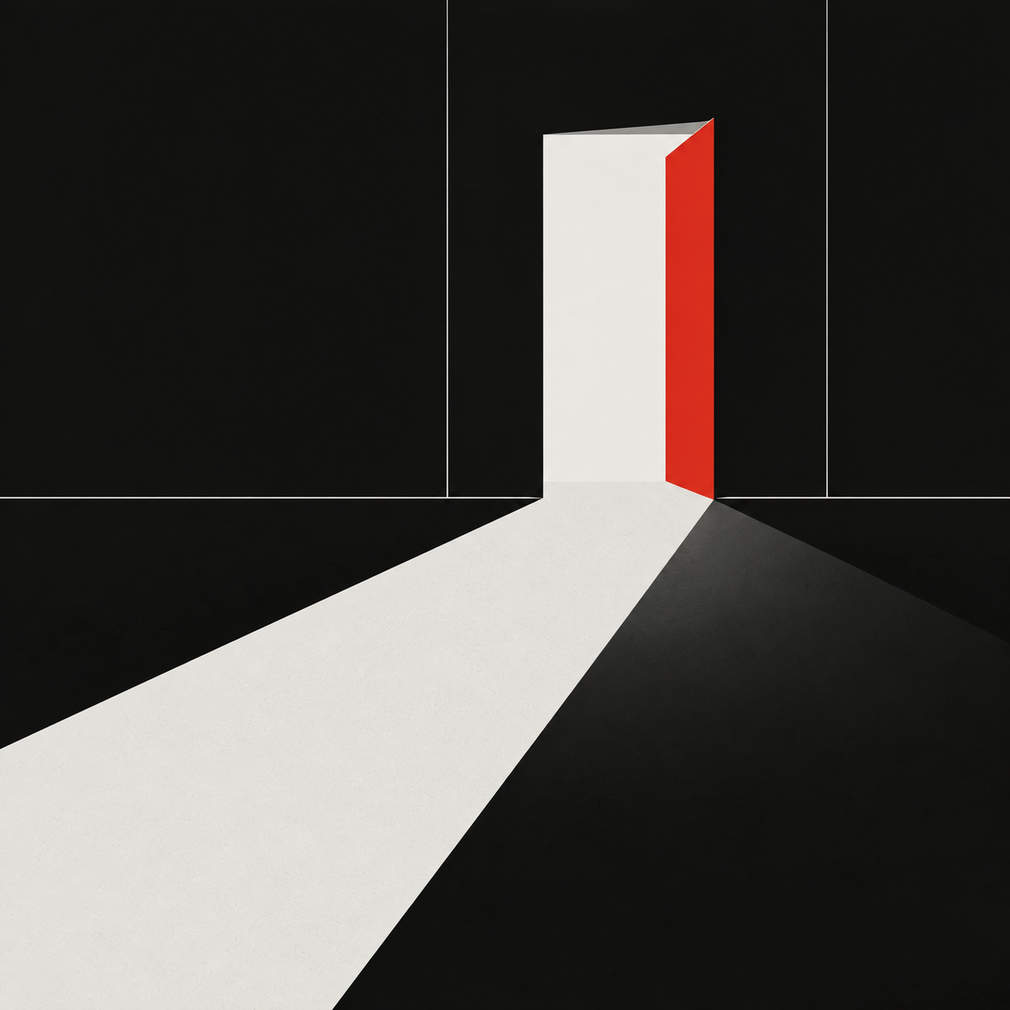
The wanting works harder. The winning pays less. The room they've spent a career building starts to show its walls. That is the first sign there's a door.
The familiar response is to walk straight past. Not out of denial exactly. Out of fluency. A foundation gets started. A new industry gets entered, one they have no business being in, which is precisely the appeal. A sports team, a run for office, a legacy project with their name carved somewhere permanent. Every one of these is legible to the same machinery that built the fortune in the first place, it's just a new mountain, and the muscle knows exactly what to do with a mountain. So the climbing resumes, the familiar relief returns, and the door gets missed again. Sometimes for another decade. Sometimes forever.
Some stop at the threshold instead of reaching for the next peak. And what they find, if they stay still long enough to look at it, is strange enough to be worth describing precisely.
The locks they know respond to more: more leverage, more information, more nerve, more patience than whoever is on the other side. When one doesn't open, the question is what they're missing and how to get it. Change the approach. Improve the position. Come back better equipped. Even failure stays inside the same logic.
This one doesn't work that way. A cleverer key won't help. It runs on a different axis entirely. You cannot out-negotiate it. You cannot hire the advisor who's already solved it. You cannot apply more of the thing that has served you everywhere else, because "more" is simply the wrong variable.
This is what should unsettle anyone good at getting what they want: the exact strength that built everything can be what keeps them outside this one room. A key perfect for one lock can be the wrong shape for another. Sharpening it further doesn't change the shape.
So what's actually behind it?
The mind reaches for what it knows: another secret, a deeper one, in the same currency as the secrets they've spent a career collecting. Some insider read on how reality "really" works, a piece of information that, once acquired, could be leveraged the way everything before it was leveraged. But however rare that information, acquiring it would still be the same kind of move. A harder version of the same game.
Behind the door, something falls away. The distance between the life that is happening and the conditions under which a person has agreed to actually inhabit it. The next acquisition, the next position, the next number was supposed to close that distance. Sometimes it closed a real one: between insecurity and security, dependence and freedom, an idea and something that existed. Those changes mattered. But alongside the practical gains ran another promise: after this, I will no longer need the next thing in the same way.
The promise survives by moving. The person revises the number, the ambition, the explanation of what was missing. What rarely gets revised is the arrangement itself: that something further must happen before the present becomes sufficient.
And the arrangement reaches further than ambition. A conversation becomes a position to read. A friend is talking and before the second sentence the mind has already filed it: relevant, actionable, or neither. An afternoon becomes time well spent or time wasted. Even rest has to justify itself by what it will make possible afterward. The person can have an extraordinary range of experiences while encountering almost all of them through the same narrow question: what does this do for me? The instrument is so practiced, and so frequently useful, that its mediation stops registering. It feels like seeing.
Setting it down does not mean losing the ability to think, build, judge, or act. It means those abilities no longer have to stand between a person and everything they encounter. A conversation can be heard without being worked. Something can receive attention without first proving that the attention will pay. The reduction is in what they require everything to do for them.
Of course, the trained mind can immediately recognize an opportunity here. Perhaps letting go is what will finally make the achievements satisfying. Perhaps this is the missing technique, the last adjustment that will make the whole arrangement work.
And there it is again. The instrument has picked up the instruction to put itself down and started calculating the return.
This is why the door cannot be approached as the final acquisition. As long as setting something down is a transaction undertaken to receive something better, the grip has not opened. It has merely become more sophisticated about what it expects to be paid.
No replacement bargain. No guaranteed feeling, no permanent state, no answer that can be carried back into the room and displayed. To someone who has spent a lifetime making sure that every move improves their position, this looks like walking away empty-handed.
Their capacity to build remains intact. So do the things already built. What they cannot carry through is the requirement that this, too, turn out to be a way of getting more.
Who actually walks through, then?
Sometimes it's people the game broke rather than crowned. A bankruptcy. A disgrace. A diagnosis. A death close enough that no leverage on earth could negotiate with it. Losing the identity built by winning can interrupt the machinery that kept pointing toward the next thing. In that interruption, some see the door for the first time.
Loss alone does not guarantee this. Plenty of people lose everything and spend the rest of their lives rebuilding the exact same arrangement. Something breaking and someone seeing what broke are not the same event. The collapse can simply give them another mountain.
Occasionally someone finds the door with nothing broken at all. Everything is working. The machine is running. And in the middle of a perfectly good Tuesday, standing in the house they built, the rooms quiet except for the air conditioning, they notice it: the gap between how hard the engine is running and how little of the ride they can feel. The pull to build over it fires the way it always does. For once they don't follow it. The floor holds. That's the surprise.
What they built stands. The question is what they keep asking it to settle.
The mountain is real. The door was never another peak. Building one more magnificent structure beside it and calling that "meaning" or "legacy" still leaves a person standing outside.
The door has been in plain sight the whole time, unguarded. Standing in the same room as every deal that ever closed. And the people strong enough to force open every other door in the building can be the very last ones to try the one that only opens toward less.
What is behind the door?
Behind the door is peace - not the peace of having finally gotten or won enough, but the peace of no longer needing the next thing to settle what the last one couldn't.
Wanting stays. Ambition stays. You can still build, compete, love, lose, begin again. What's gone is the hidden requirement that any of it has to make something finally come right.
The future stays open. It just stops holding the present hostage.
So you build because building is worth doing. Win and let the win be enough. Rest without earning it. Love without needing proof. Face death without asking life to cancel it out.
Not less life. The same life, with less weight on every next thing.
The mountain is still there. You're just free to climb it without needing the summit to save you.
But none of this arrives by reading it. You still have to walk through the door yourself.