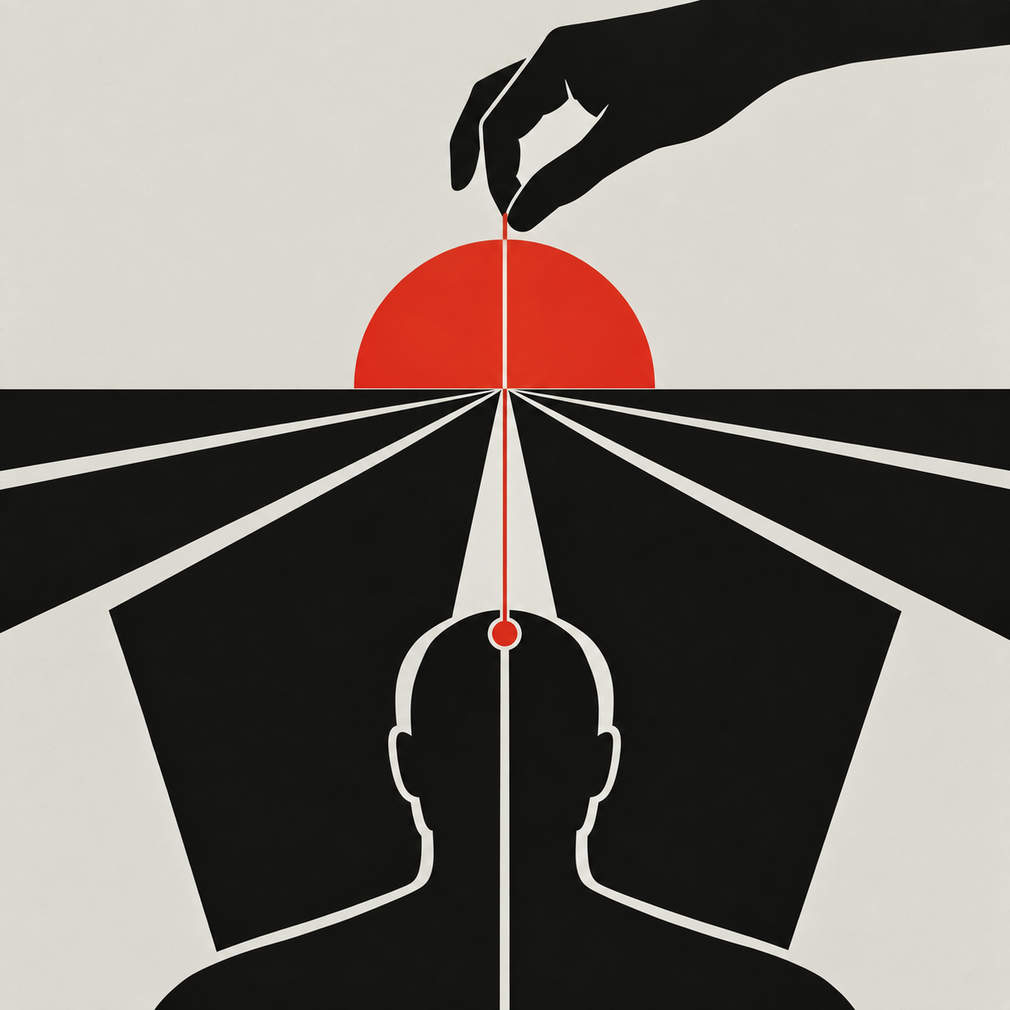
 There is a gap between what is actually happening and the story a person tells themselves about what is happening. Most bad decisions live in that gap.
Everyone has had the experience of a pull-back, a moment before a bad decision when something in them resisted, and they overrode it. They had reasons. The reasons sounded good. Later, sometimes years later, they recognized that the resistance was more accurate than the reasoning. The interesting question is what that resistance actually is, and why it's so easy to override.
The body often reacts before conscious deliberation catches up. Before someone decides they're uncomfortable, their shoulders have already tightened. Before they realize a project excites them, their breathing has changed. The conscious mind arrives late and constructs an explanation, usually one that fits what they already believe is acceptable to feel. The explanation overwrites the data. This happens so routinely that most people cannot tell the difference between what they actually registered and what they later decided they had registered.
People absorb goals the way they absorb an accent. Live somewhere long enough and you start sounding like everyone around you. Desire works the same way. Spend enough time in an environment and you start wanting what it rewards, until there is no felt difference between what you absorbed and what originated in you. Introspection does not solve this. The question “what do I really want?” returns whatever narrative has been rehearsed most recently, because the instrument doing the introspecting has been shaped by the same forces it is trying to see past.
There is the analytical kind of attention applied after the fact - “why did I get defensive?” - and the concurrent kind: catching the reaction while it is still forming, feeling the chest tighten and the visual field narrow mid-sentence. In that sliver between the trigger and the habitual response, something other than the habit becomes possible. This is the entire mechanism. There is nothing behind it: no deeper technique, no advanced stage.
Staying in that sliver is difficult because it means tolerating the raw sensation the habitual response was built to discharge. Without the justification or the counterattack, there is just the unpleasant charge with nowhere to put it. The search for an exit, a reframe, a distraction, collapses the attention back into the pattern. The structure is the same as trying to fall asleep by trying to fall asleep: the effort activates exactly the systems that need to quiet down.
The body is also conditioned. Anxiety tightens shoulders. Trauma changes breathing. Old fear fires in situations that are unfamiliar but not dangerous. The same somatic channels that carry accurate information about a bad job also carry panic before a conversation that would actually go well. Following the body's signal uncritically is as blind as ignoring it. Noticing clearly and having room to act on what you notice are not the same thing.
There is a pattern, though, that helps with the distinction. Concurrent attention still carries conditioning in what it catches; the body's data is no cleaner than anything else the mind produces. Its advantage is timing. It beats the explanation to the moment, catching what was initially registered before that gets overwritten. That head start needs a second check to mean much, which is where the pattern comes in. The test isn't the shape of the fear on first contact. Conditioning can feel every bit as specific as real danger. It's what happens when attention holds on it a moment longer. A real threat tends to hold its shape: the picture stays coherent the closer you look, and sometimes gets sharper. A conditioned reaction often moves: it finds a new detail to attach to, relocates when the first justification gets examined, needs the story to keep growing to stay convincing. This is a heuristic. Real threats can become ambiguous under scrutiny, and old conditioning can be remarkably stable. What matters is that awareness includes discernment: not just noticing the reaction, but staying with it long enough to see whether it holds its shape or starts working to survive the attention.
Much of what people call desire turns out to be momentum. The same machinery that can conceal a reaction for five seconds can conceal a direction for years. It keeps running because stopping would mean confronting years spent moving in a direction that was never theirs. When attention becomes more consistent, some of that momentum loses force on its own.
What follows isn't relief. For a while there is nothing where the wanting used to be: no direction, no reason to move, not yet anything to replace it with. Mornings can feel flatter; decisions that once seemed obvious lose their charge. The silence has the uneasy quality of a room after a machine shuts off, when you suddenly notice how much noise had been there all along. The impulse is to fill it quickly, to start another machine so movement can resume. Given enough room, instead, something quieter becomes legible.
Whether this counts as discovering what someone "really" wants, or is simply what's left once the borrowed wants burn off, isn't a question the practice needs to settle. Settling it with any confidence would be exactly the kind of story this whole essay is warning against.
None of this accumulates into a permanent state. There is no arrival. What remains is a narrowing of the gap: getting faster at catching the story as it forms, getting better at feeling the difference between a signal worth following and old machinery still running.
The gap narrows. It does not close.
But a person operating with a narrow gap between what is happening and what they think is happening makes drastically different decisions than one who never noticed the gap was there.